Historic Center of Puebla · Craft market

Mercado de Artesanías El Parián (Puebla)

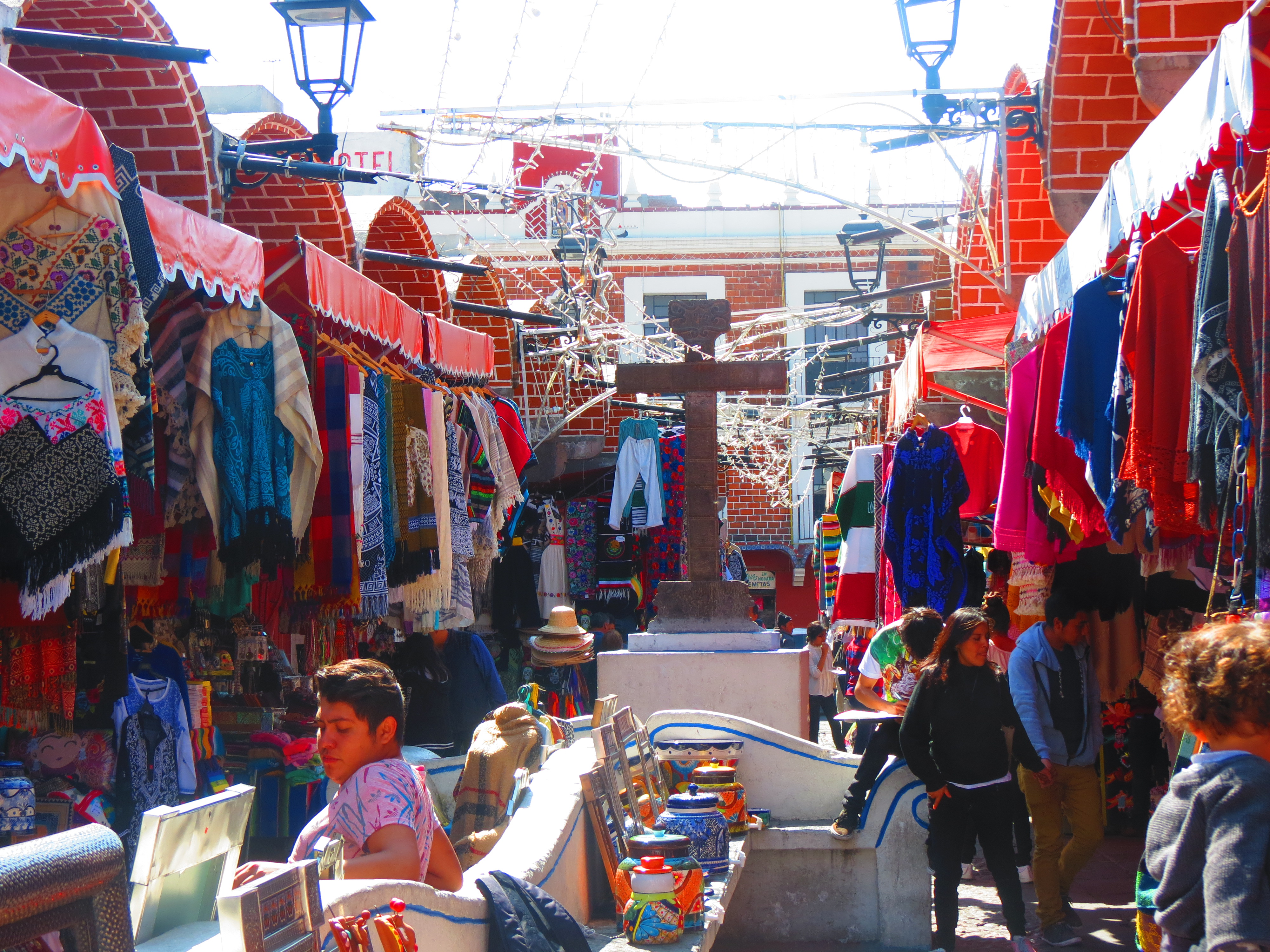
The Mercado de Artesanías El Parián —simply known as El Parián de Puebla— is a corridor of brick, tile and Pueblan crafts: a classic stop to discover ceramics, textiles, onyx, clay and souvenirs in the heart of the Historic Center of Puebla, in the state of Puebla, Mexico.

10:00–20:00Hours published by municipal tourism1801Historical reference of the market4.5 / 528,579 reviews on the provided sheet
01

Mercado de Artesanías El Parián
Puebla de Zaragoza, Puebla, Mexico

02

Plazuela de San Roque
Historical antecedent of the area

03

Pueblan crafts
Ceramics, textiles, onyx, clay and glass

A plaza turned market

El Parián and the commercial memory of Puebla

The tourist history of Puebla links El Parián to the old Plazuela de San Roque and places its formation as a market in 1801. The ensemble keeps a very recognizable image: brick facades, tile details and small shops lined along the corridor.

The origin of the building goes back to a January dawn in 1796: a fire of undocumented cause destroyed 23 wooden stalls of the Portal de las Flores, facing the Cathedral. Intendant Manuel de Flón then commissioned architect Antonio Santamaría Inchárragui to design the new units, built in the old Plazuela de San Roque and giving shape to the Parián walked today.

For more than a century and a half the space operated as a general market, a point of arrival and resale of goods. In 1961 it formally became the typical crafts market: about 112 shops that today concentrate ceramics, textiles, onyx, glass, clay and sweets from different regions of the state.

Today it works mainly as a crafts market. Its value for the visitor is not only in buying a souvenir, but in recognizing materials and techniques linked to Pueblan identity, within a Historic Center inscribed on the UNESCO World Heritage List since 1987.

Verified entity: this guide uses the full name, location, geodata and cross-references from municipal and state tourism to avoid confusing El Parián de Puebla with markets of the same name in other cities.

From the plaza to the market

A history in five moments

  1. 1531

    Founding of the city

    Puebla de los Ángeles is founded, and the area that El Parián occupies today becomes a space of commerce and transit from the city’s earliest centuries.

  2. 1796

    The fire at the Portal de las Flores

    On January 7, the night after Día de Reyes (Three Kings’ Day), 23 wooden stalls in front of the Cathedral are destroyed by a fire of undocumented cause.

  3. 1801

    El Parián is born

    At the request of intendant Manuel de Flón, architect Antonio Santamaría Inchárragui designs the commercial units in the old Plazuela de San Roque.

  4. 1961

    A traditional crafts market

    The space is formally established as the city’s crafts market, concentrating Puebla’s artisanal offer from different regions of the state.

  5. 1987

    UNESCO World Heritage Site

    The Historic Center of Puebla, of which El Parián is part, is inscribed on the World Heritage List for its urban and architectural value.

Stories and legends

What is rarely told about El Parián

Documented history

A night of fire in front of the Cathedral

On January 7, 1796, the day after Three Kings’ Day, a fire of undocumented cause consumed 23 wooden stalls at the Portal de las Flores, facing the Cathedral’s Sagrario. The commercial plaza was left in ashes and the city had to relocate its merchants.

Documented history

The intendant and the architect

Intendant Manuel de Flón (1786–1811), the first governor with that title in Puebla, commissioned architect Antonio Santamaría Inchárragui to design the new units. The same architect authored the Casa de Alfeñique and the Fuente de San Miguel, leaving his signature on several key pieces of Puebla’s heritage.

Origin of the name

A name that crossed the ocean

The word “parián” is attributed to an origin linked to Asian trade: in Manila, the Parián was the quarter of Chinese merchants or sangleyes. The word is said to have reached New Spain with the transpacific trade of the Manila Galleon.

Local tradition

The muleteers and the Plaza del Varadillo

Another popular explanation links the name to the muleteers who crossed the area bringing goods from Veracruz, Oaxaca and Guerrero. The old plaza was known as Plaza del Varadillo, and its vocation as a passage and barter point preceded the current building.

Documented history

From a general market to a crafts showcase

For more than a century and a half El Parián operated as a general market. In 1961 it formally became the typical crafts market, concentrating the production of different towns of Puebla in a single walk.

Local tradition

Talavera with a protected name

The ceramics sold at El Parián today follow a 16th-century tradition. Only pieces made in certified workshops may use the “Talavera” denomination of origin; when buying, it is worth asking about certification and provenance.

What to look at closely

Crafts that tell Puebla

✦

Ceramics and Talavera

Plates, tiles and decorative pieces with the chromatic language that identifies Puebla. Certification matters if you look for protected Talavera.

⌁

Textiles and embroidery

Garments, tablecloths, accessories and embroidered pieces that gather regional motifs and manual work.

◆

Onyx, clay and glass

Utility and decorative objects in materials usual to the Pueblan craft offer.

✺

Miniatures and sweets

Small souvenirs and regional specialties easy to add to a walk through the Historic Center.

Practical plan

Visit El Parián without improvising

Hours

Monday to Sunday · 10:00–20:00

Hours published by the Tourism Office of the Municipality of Puebla. On holidays or extraordinary events it is worth reconfirming.

Cost

Free entry in municipal guides

City Council guides have listed El Parián as free entry. Buying crafts is separate, and extraordinary conditions should be verified for special events.

Best time

10:00–12:00 on weekdays

This is an editorial recommendation to walk more calmly; it is not an official low-attendance schedule.

Duration

45–75 minutes

Allow up to 90 minutes if you want to compare pieces, talk to sellers or add nearby museums.

Before you go

Weather in Puebla City Center

Current conditions and a multi-day forecast to plan your visit to El Parián. It refreshes every time you open the page.

Loading current weather…

Services and amenities

What is around the market

El Parián does not advertise its own services for visitors, but the city center offers what is needed for a comfortable visit. This guide mentions types of service, not specific businesses.

Restrooms

Public restrooms

Around the Historic Center there are public restrooms and facilities in establishments that usually require a small fee or a purchase. It helps to locate the nearest one before walking the market.

Usually paid
Parking

Parking and arrival by car

The market does not advertise its own parking for visitors. A few blocks away there are paid public parking lots; check rate, hours and maximum height before entering.

No on-site parking
Food

Nearby food and drinks

The area concentrates fondas, cafés and restaurants of Pueblan and Mexican cuisine: mole, chalupas, cemitas, molotes and traditional sweets. There are also street-food stalls around.

Pueblan and Mexican cuisine
Lodging

Where to stay nearby

The Historic Center offers hotels, hostels and guesthouses of different ranges. Booking ahead helps in high season and on long weekends.

Hotels and hostels in the Center
Shops

Stores and groceries

In the city center there are convenience stores, pharmacies and small shops covering basic needs during the walk.

Convenience in the center
Fuel and charging

Gas stations and EV charging

Gas stations are located on the main avenues outside the city center. Some parking lots in the area have chargers for electric vehicles.

On nearby avenues
Health

Pharmacies and medical care

There are pharmacies in the Historic Center and nearby emergency services. For major medical care, go to public or private hospitals in the metropolitan area.

Pharmacies in the area
Cash

ATMs and payments

There are ATMs in the city center. Cash is still useful: many market stalls operate mainly in cash, although some accept cards or transfers.

Bring cash

Getting around

How to get there and where to park

From Puebla International Airport (PBC)

PBC (Hermanos Serdán) is about 25–35 km from the Historic Center. By taxi or ride app the trip usually takes 25–40 minutes depending on traffic; there is also bus service and car rental counters at the airport. As destination indicate “Mercado de Artesanías El Parián, Centro Histórico”.

From Mexico City (AICM / AIFA)

Many people arrive by executive bus from downtown Mexico City or the AICM to the Puebla Central Bus Station (2–2.5 h), and from there by taxi or app to the Center (~15–25 min). From AIFA the time is longer; confirm schedules on the day.

On foot from the Zócalo

El Parián is within the Historic Center and fits well into a walking route from the Zócalo, the Cathedral and the museum zone. The walk usually takes about 10 minutes depending on the starting point and pace.

Public transport

Several routes run along the axes of Boulevard Héroes del 5 de Mayo and 2 Oriente. Get off at a central stop and walk the last stretch; confirm the current route on the day.
Taxi or ride app

Use as destination “Mercado de Artesanías El Parián, Puebla”. When streets are closed or very busy, it may be more practical to get off one or two blocks away.

Parking

The municipal sheet does not advertise its own parking. There are paid public parking lots in the Historic Center, including establishments around 6 Oriente. Check rate, hours and maximum height on arrival.

Exact location

Two address references, one market

Municipal tourism: 6 Norte 205, Centro Histórico.

Provided Google Maps sheet: Mercado de artesanías El Parián local 111, 72000 Heroica Puebla de Zaragoza.

Plus Code: 2RV4+7M · Heroica Puebla de Zaragoza, Puebla, Mexico.

The difference corresponds to how different sources describe the access or the shop. For navigation, use the map pin.

Build a route

Flavors and nearby places

El Parián works best as a stop within a walk through the Historic Center.

Eat

Pueblan flavors

Look for mole poblano, chalupas, cemitas, molotes and traditional sweets. The Historic Center area concentrates multiple options; this guide does not prioritize specific businesses.

Museum

Casa de los Hermanos Serdán

One of the closest cultural visits, linked to the beginning of the Mexican Revolution.

Art

San Pedro Museo de Arte

A good complement to switch from craft commerce to a museum reading of Pueblan heritage.

Heritage

Casa de Alfeñique and Biblioteca Palafoxiana

Two key references of the Historic Center that can be added to the same walking route.

For your lens

Where to take the best photos

Framing ideas to portray the market with respect for its commercial activity.

Photography

The arcade corridor

The aisles with brick arches create ideal lead-in lines at sunrise or in the afternoon.

Photography

Talavera tiles

Get close to the facades to capture tile and brick detail with side light.

Photography

Ceramic stalls

The stacked pieces form color compositions; ask permission and shoot with respect.

Photography

Faces of the craft

Sellers and artisans at work tell stories; portray them only with their consent.

Visitor etiquette

A market is walked with respect

Recommended

  • Ask about materials, origin and certification of each piece before buying.
  • If you look for Talavera with denomination of origin, ask the workshop for certification information.
  • Compare prices at several stalls; it is part of the market experience.
  • Ask permission before photographing stalls or portraits of sellers.
  • Carry cash in small denominations to make change easier.
  • Walk calmly and give way in narrow aisles during busy hours.

Please avoid

  • Avoid touching fragile ceramic or glass pieces without asking first.
  • Do not assume everything can be bargained; do it respectfully and without pressure.
  • Do not block stall access or aisles when you stop to look.
  • Avoid photographing sellers without permission, especially if they ask you kindly.
  • Do not leave personal items unattended; in crowded areas watch your wallet and phone.

When to go

Visit strategy by season

Puebla has a highland climate: the rainy season (Jun–Oct) brings afternoon showers, while the rest of the year is dry and mild. This guide uses typical regional climate averages to help you choose the best time, not point predictions.

SeasonTypical climateRecommendationWhat to bring
Winter
Dec – Feb
Cool highland climate: nights of 8–12 °C, days 18–22 °C. Occasional cold fronts (“nortes”).Good light and little rain for photographing the arches; bring a light jacket for the afternoon and night.Jacket, light layer
Spring
Mar – May
Dry and pleasant: days 22–27 °C. Local festive season (Holy Week, city anniversary).One of the best times to walk; book ahead for Holy Week and long weekends.Sunglasses, water
Summer / rains
Jun – Oct
Afternoon rains, cool nights; days 20–25 °C. The highland rainy regime.Visit in the morning; bring an umbrella or raincoat and comfortable shoes for the aisles.Umbrella, comfortable shoes
Autumn
Oct – Nov
Dry transition: days 20–24 °C, clear skies and good visibility.Excellent to combine the market with the city-center museums without rush.Layered clothing

Real conditions vary year to year; always check the forecast close to your visit date (weather module above).

Your type of visit

Routes by visitor profile

Three suggested routes by pace and purpose. We do not recommend specific businesses: only types of experience and services.

Families

Family route

Short, ground-floor route with breaks and options for children.

  • Start at the ceramics, miniatures and traditional sweets stalls.
  • Pueblan food stop in the city center (mole, chalupas, cemitas).
  • Locate nearby public restrooms before starting the walk.
  • Close with an accessible neighboring museum (San Pedro or Casa de Alfeñique).
Photography

Light and detail route

Designed to capture arches, tile and the craft with respect.

  • Arrive between 10:00 and 11:00 for raking light on the arches and aisles.
  • Get close to tile and brick; avoid direct flash on pieces.
  • Ask permission before portraying stalls and artisans.
  • On rainy afternoons, use interiors and saturated color.
Reduced mobility

Low-effort route

Ground-floor corridors and shade breaks; no stairs in the main area.

  • Walk the main ground-floor aisles, avoiding ramps with level changes.
  • Alternate with shade breaks between aisles.
  • Use the benches and waiting areas of the city center.
  • Confirm access conditions on the day, as it is a historic building.

Plan your route

Suggested itineraries

Two options depending on available time. Combine them with the city-center museums.

Half day

Half-day itinerary

Estimated duration: 2.5 – 3 h

  1. 10:00 · Mercado de Artesanías El Parián (45–75 min).
  2. Zócalo and Puebla Cathedral (30 min walk).
  3. Typical lunch in the Historic Center (45 min).
  4. Return or complementary crafts stop.
Full day

Full-day itinerary

Estimated duration: 5 – 6 h

  1. 10:00 · Mercado de Artesanías El Parián.
  2. Casa de los Hermanos Serdán (history and Revolution).
  3. San Pedro Museo de Arte.
  4. Lunch in the Historic Center.
  5. Biblioteca Palafoxiana and Casa de Alfeñique.
  6. Cathedral and Zócalo at sunset.

Citizen science and respect

Visitor responsibility

El Parián is a living space of commerce and craft. These guidelines help care for it and understand it better, without promoting specific brands or businesses.

Authenticity of the craft

Ask about material and provenance; Talavera with denomination of origin only comes from certified workshops. Comparing at several stalls is part of the experience.

Respect for commerce

Ask permission before photographing stalls and people, and do not block aisles or accesses when you stop to look.

Zero waste

Bring a reusable bag and water bottle; dispose of trash in the containers of the Historic Center.

Sun and altitude

Puebla is at ~2,135 m; wear a cap and sunscreen, even on cloudy days, and stay hydrated.

Afternoon rain

In the rainy season (Jun–Oct) bring an umbrella; mornings are usually clear and ideal for walking.

Safety and health

Watch personal items in crowded areas; there are pharmacies and care nearby in the city center.

Frequently asked questions

El Parián Puebla FAQ

What are the opening hours of El Parián in Puebla?

The tourism office of the Municipality of Puebla publishes hours from Monday to Sunday, 10:00 to 20:00. It is worth checking for extraordinary changes on holidays or special events before going.

Is there an entrance fee to visit the Mercado de Artesanías El Parián?

Guides published by the Puebla City Council have listed El Parián as free entry. Purchases at the stalls are paid separately, and any extraordinary condition should be confirmed if there is a special event.

What handicrafts can be found at El Parián?

It is known for Pueblan ceramics, Talavera-style pieces, textiles, embroidery, onyx, glass, clay, miniatures and regional sweets. If you look for Talavera with denomination of origin, ask the seller for its certification.

How much time is worth spending at El Parián?

As an editorial recommendation, allow 45 to 75 minutes. If you plan to compare pieces, take photos or combine the visit with nearby museums, 90 minutes is more comfortable.

Is there parking inside the market?

The municipal tourism sheet does not advertise its own parking for visitors. In the Historic Center there are paid public parking lots; check signage, rates and hours on arrival.

Is it worth bringing cash?

Yes. Payment methods depend on each stall, so carrying some cash can be useful even if some sellers accept cards or transfers.

Are there public restrooms near El Parián?

The market does not advertise restrooms for visitors. Around the Historic Center there are public restrooms and facilities in establishments, usually with a small fee or a purchase. Locate the nearest one before starting the walk.

Where to eat near El Parián?

The city-center area concentrates fondas, cafés and restaurants of Pueblan and Mexican cuisine. This guide does not prioritize specific businesses: look for mole poblano, chalupas, cemitas, molotes and traditional sweets.

Is it accessible for people with reduced mobility?

The market occupies corridors and aisles in a 19th-century historic building, so there may be steps and narrow aisles. The official information does not publish a specific accessibility plan; it is worth verifying conditions on the day.

Are photographs allowed in the market?

Generally yes, and it is part of the experience. As a courtesy, ask permission before photographing stalls or portraits of sellers, and avoid interrupting commercial activity.

Are there hotels near El Parián?

The Historic Center of Puebla has hotels, hostels and guesthouses of different ranges, a short walk from the market. In high season it is worth booking ahead.

Can I get to El Parián by public transport?

Yes. Several routes run along the axes of Boulevard Héroes del 5 de Mayo and 2 Oriente. Get off at a central stop and walk the last stretch; confirm the current route on the day.

Reference sources

Cross-checked information, not official affiliation

Editorial note: this independent, non-profit guide contrasts information with official municipal, state and national tourism sources, plus historical publications on the 1796 fire, the origin of the name “parián” and the conversion of the building into a crafts market in 1961. Last content review: September 2026.

For official and updated information, consult the Puebla State Tourism Portal or the Tourism Portal of the Government of Mexico.